











































.png)








ICoBio 2027
- Last modified at 29 September 2026
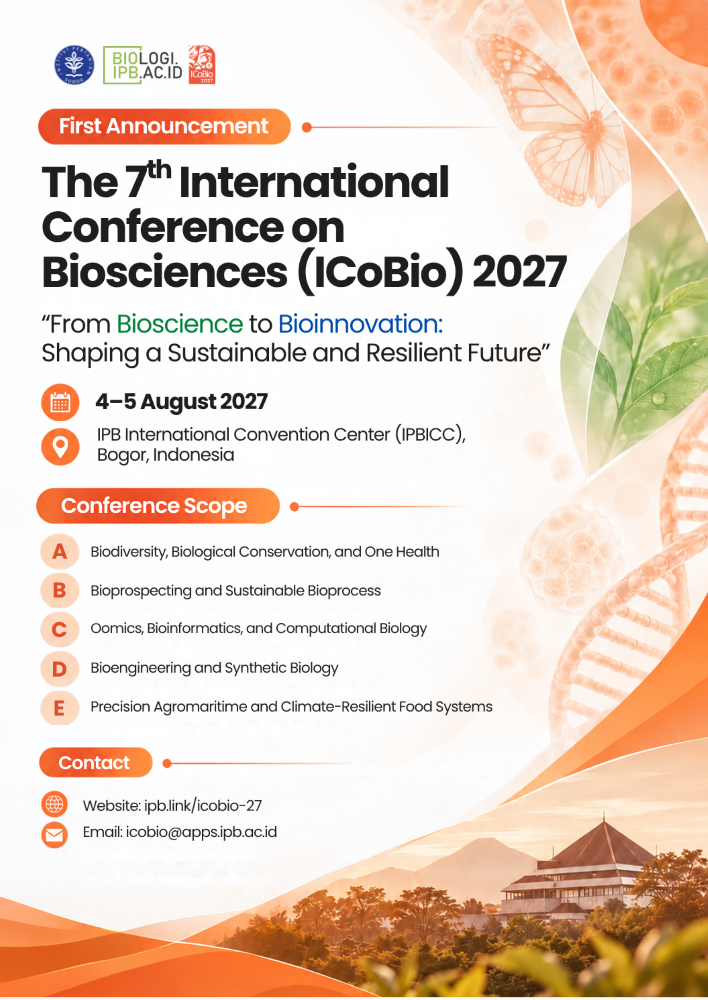
The 7th International Conference on Biosciences (ICoBio) 2027
"From Bioscience to Bioinnovation: Shaping a Sustainable and Resilient Future"
4-5 August 2027
IPB International Convention Center (IPBICC), Bogor, Indonesia.
Call for Papers
Type of Presentation
- Oral Presentation
- Poster Presentation
Scope
A. Biodiversity, Biological Conservation, and One Health
Biodiversity and Biological Conservation are outcomes of scientific studies that seek social and economic benefits and may be linked to the One Health perspective. This topic includes (1) Genetic biodiversity (study at gene level); (2) Species biodiversity (the study of varieties of species in nature); (3) Ecosystem biodiversity (species diversity with their habitats); and (4) One Health (the interconnection of human, animal, and environmental health). Biodiversity, conservation biology, one health can also be the basis to analyse and answer the sustainable development goals criteria: (1) in basic & social sciences (taken from nature's perspective and understanding); (2) as the backbone of applied sciences (agriculture, aquaculture, animal husbandry, forestry. etc.).; (3) basic development knowledge to better land-use pattern; (4) bio-resources utilisation; (5) societal and cultural context (based on local/global biodiversity); (5) human development; (6) basis of general law (biodiversity & biology as the basis of dynamic stabilisation law in complex systems).
B. Bioprospecting and Sustainable Bioprocess
Bioprospecting and Sustainable Bioprocess focus on the exploration of natural sources and sustainable resource utilization. It includes small molecules, macromolecules, and genetic materials. These natural resources can be developed into commercially valuable products for agriculture, bioremediation, health issues, cosmetics, and the pharmaceutical industry. Sustainable bioprocesses mainly rely on processes that use a complete living cell or its components (lysates, enzymes, exosomes) to obtain desired products for sustainable use.
C. Omics, Bioinformatics, and Computational Biology
Omics, Bioinformatics, and Computational Biology focus on how biological problems are interpreted and analyzed, and of applying bioinformatics solutions to them. The biological problems in this topic include (1) genetics; (2) epigenetics; (3) genomics; (4) proteomics; (5) metagenomics; (6) transcriptomics; (7) phylogenetics; (8) metabolomics; (9) systems biology; (10) structural analysis; (11) molecular modeling; (12) pathway analysis; (13) computational bioengineering; (14) computational biomechanics; (15) computational bioimaging; (16) mathematical biology; and (17) theoretical biology.
D. Bioengineering and Synthetic Biology
Bioengineering and Synthetic Biology focus on the application and integration of engineering principles, biotechnology, and biological sciences to understand, design, modify, and develop biological systems and bio-based technologies. This topic includes biomedical and biosystems engineering, such as regenerative medicine, tissue engineering, drug delivery, diagnostic technologies, biomaterials, nanobiotechnology, biosensors, and health-monitoring systems; biochemical and cellular engineering, including protein and enzyme engineering, metabolic engineering, cell-based technologies, and bioprocess development; as well as synthetic biology, including the design and construction of genetic circuits, genome and pathway engineering, microbial cell factories, CRISPR-based technologies, and the engineering of microorganisms for the sustainable production of pharmaceuticals, chemicals, biomaterials, biofuels, food ingredients, and other high-value bioproducts. The scope also covers biosensing, bioelectronics, bio-inspired systems, and engineering approaches for environmental applications, bioremediation, and sustainable biomanufacturing.
E. Precision Agromaritime and Climate-Resilient Food Systems
Precision Agromaritime and Climate-Resilient Food Systems focus on the application of science, technology, and innovation to develop productive, sustainable, and resilient agricultural, fisheries, aquaculture, and integrated land–water food systems. This topic includes precision agriculture and aquaculture, smart farming and mariculture, remote sensing, agricultural drones, satellite imagery, IoT-based sensor networks, environmental and weather monitoring, automated irrigation and resource management, and data-driven systems for crop, livestock, fisheries, and disease and pest management. It also covers climate-resilient food production, including resilient crops and aquatic organisms, sustainable soil and water management, biotechnology, ecosystem-based approaches, climate-smart production technologies, and strategies to maintain food security, resource efficiency, ecosystem health, and the livelihoods of farmers, fishers, and communities. The scope further encompasses artificial intelligence, predictive modeling, digital technologies, and integrated analytical approaches to support decision-making and enhance the resilience and sustainability of food systems.
Login
LoginSitemap
map